By Sonya Nightingale | @sonyasjoys
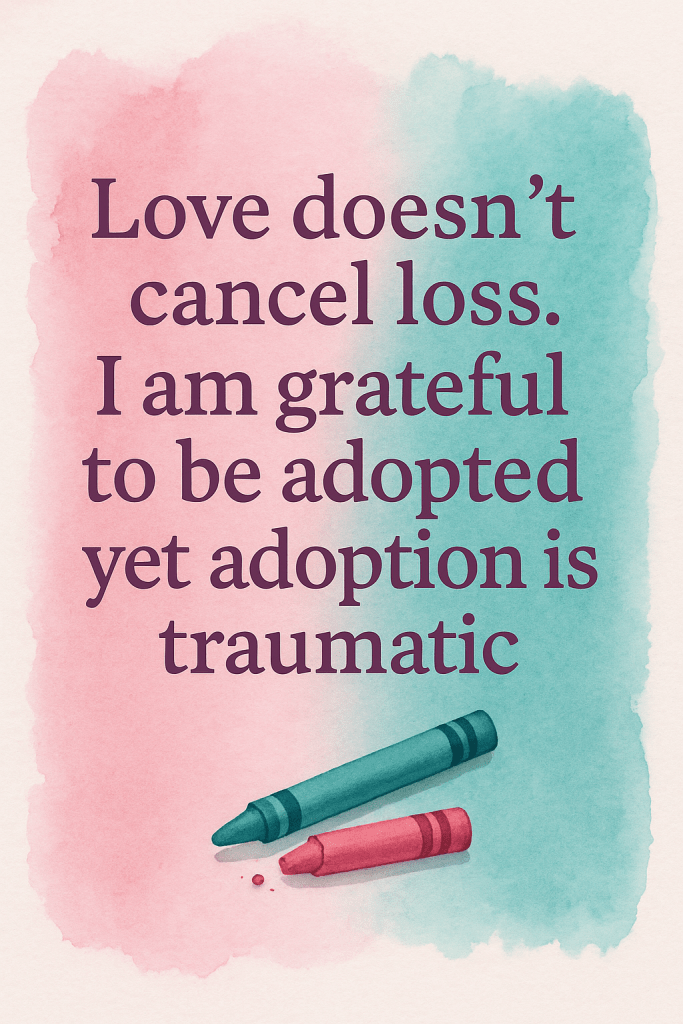
“Love doesn’t cancel loss. Being grateful for my upbringing doesn’t mean pretending the trauma didn’t exist. Both can be true.”
November is National Adoption Month — and while adoption can be filled with love, it can also carry a lifetime of layered emotions that don’t always fit into neat little boxes.
For me, adoption has been both a gift and a wound. I’ve dealt with severe depression and for years was diagnosed with bipolar disorder. I was on medication and in treatment for a long time, but about five years ago that diagnosis was changed to Asperger’s (now recognized as part of the autism spectrum). That shift helped me understand myself in a whole new light — the sensory overload, the emotional intensity, the deep empathy, and the constant overthinking that had never quite made sense before.
I’ve spent time in inpatient treatment and have attempted suicide four times. Statistics tell us that adoptees are four times more likely to attempt suicide than non-adoptees and experience mental health challenges at a much higher rate.
And yet, on paper, adoption treated me beautifully. I had loving parents who cared for me the best they knew how. I never wanted for love or material comfort.
But adoption isn’t a fairy tale — nor is it a horror story. Like most things in life, it lives somewhere in the gray in-between.
–
It’s Not Black and White
Social media loves extremes: anti-adoption advocates often compare adoption to trafficking, while adoptive parents sometimes paint it as a “happily ever after.” But for many of us, it’s both — and neither.
Growing up blessed doesn’t erase the trauma of being separated from my birthmother almost immediately after birth. I didn’t understand that until much later, when I learned how the body stores trauma. The book “The Body Keeps the Score” opened my eyes — and suddenly, so many of my physical symptoms began to make sense.
There’s a small child inside me — the little girl whose birth name was Charity Anne. She had no words for being given up right after entering this world. She’s spent her whole life fighting to be seen and heard… and sometimes fighting me when she couldn’t be.
She’s the chaos in my stomach. The ache behind my eyes. The pressure to prove I’m not abandonable. The years of reproductive pain, the loss of four babies, the hysterectomy, the endless surgeries. My body tells the story my mouth couldn’t.
Even now, I startle easily — jumping when the phone rings, even if I’m expecting the call. That’s hypervigilance, I’ve learned. A body that’s still braced for the next rejection. Because when your first bond is broken at birth, how could you not live on alert?
That fear of rejection seeps into relationships, friendships, even business. Something as simple as a quiet message thread can feel like abandonment. My brain knows it’s not, but my body — that small child inside — isn’t so sure.
—
Nurture and Nature
I understand, intellectually and emotionally, that my birthmother made the right choice. She was young, struggling, and escaping an abusive father — a man who should have protected her. I was her second baby in just over a year. She did what she had to do to survive, and in turn, she gave me the chance to survive too.
I don’t fault my adoptive parents for anything either. They loved me, provided for me, and gave me opportunities. But love doesn’t cancel loss. Being grateful for my upbringing doesn’t mean pretending the trauma didn’t exist. Both can be true.
If trauma rewires the brain, then maybe my wires got crossed at birth — or even before. Maybe nurture saved me from my nature. Or maybe, no matter which path I’d taken, the pain just would have worn a different name.
Many people have told me, “Anyone can have issues — it’s not just adoptees.” And I agree with that, to an extent. But I’ve also noticed patterns — higher rates of struggle, disconnection, and searching among adoptees, especially in structured or faith-based communities. There’s something unique about the kind of pain that comes from a severed attachment at birth. Some adoptees may not feel its full weight until much later in life, but it often surfaces eventually, no matter how well they’ve learned to cope.
—
Faith and Healing
People often say God heals all wounds. I believe He can — but as an adoptee, trusting God hasn’t always been easy. When you’ve felt abandoned, even subconsciously, it’s hard not to project that onto Him. Will He leave too? Will He answer this time?
I’ve prayed for safety, for physical healing, for love, for peace in my mind — and sometimes those prayers felt unanswered. But looking back, I can see He was there — not removing the pain, but walking me through it. Giving me people who love me, and the courage to keep going even when I didn’t want to.
—
Becoming Whole
After years of therapy, prayer, and learning, I’ve realized that healing isn’t about erasing the pain — it’s about making space for both gratitude and grief. I can honor the woman who gave me life and the parents who raised me. I can grieve what was lost and still celebrate the life I’ve built.
Maybe healing looks like acknowledging that small child inside of me — Charity Anne — holding her close, and whispering, “You made it. You’re safe now.”
Maybe it’s realizing that adoption gave me both the canvas and the paintbrush.
Some adults gave me the tools — but it’s up to me to take them and paint my own life.
—
Disclaimer
Parts of this essay were inspired by and adapted from another piece written by an adoptee. I’ve personalized and expanded it with my own experiences, reflections, and faith journey to share my truth and shed light on the complexity of adoption.
 Sparkling Escapades Abroad with the Fairy Bra Mother
Leave a comment